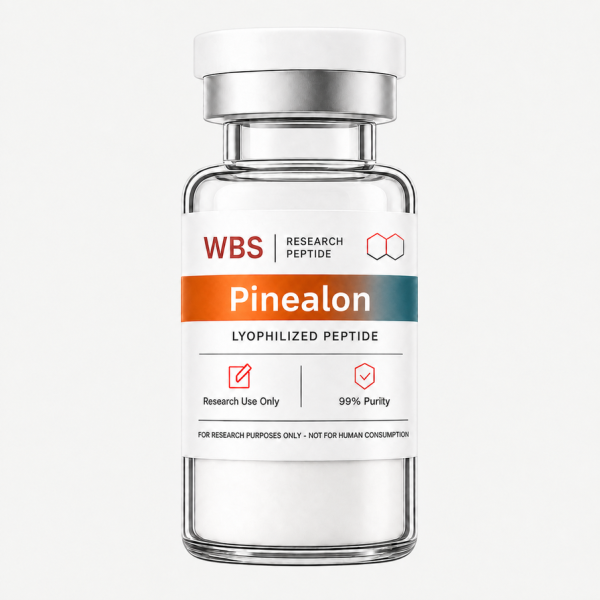
Pinealon (EDR; Glu-Asp-Arg) is a synthetic three-amino-acid research peptide studied in cell and animal models involving oxidative-stress responses, neuronal survival, neuroplasticity, and short-peptide interactions with nuclear DNA. It is supplied as a lyophilized powder at 10 mg per vial, with 10 vials per kit. The evidence is predominantly preclinical and does not establish clinical efficacy. For laboratory research use only.
These are order-level reviews from the same warehouse, not ratings of this individual product.
Pinealon does not have a validated single cell-surface receptor or an established clinical mechanism. Research has instead examined several cellular responses that may be relevant to oxidative stress and neuronal model systems.
Oxidative-stress and cell-survival observations: in cultured cerebellar granule cells, neutrophils, and PC12 cells exposed to experimentally induced oxidative stress, Pinealon was reported to restrict reactive-oxygen-species accumulation in a dose-dependent manner and reduce necrotic cell death. The same study reported delayed ERK1/2 activation and changes in cell-cycle behavior. These are in-vitro observations and do not establish an antioxidant or neuroprotective effect in humans.
Nuclear and DNA-interaction hypothesis: fluorescence-label experiments reported that EDR-class short peptides could enter HeLa-cell nuclei. Separate in-vitro binding assays found preferential interaction with deoxyribooligonucleotides containing CNG sequences. These simplified systems support a gene-regulation hypothesis, but they do not prove a specific genomic target, downstream transcriptional program, or dominant mechanism in a whole organism.
Animal-model research: studies in rat offspring exposed to prenatal hyperhomocysteinemia reported changes in spatial-learning measures, reactive-oxygen-species accumulation, and cerebellar-neuron survival. Later work in neuronal cultures and a 5xFAD mouse model examined dendritic-spine preservation and computationally proposed gene-regulatory targets. These results remain model-specific and require independent replication.
Evidence boundary: Pinealon is not an approved medicine. Human reports in the literature are limited and do not provide the independent, well-controlled evidence needed to establish efficacy, safety, dosing, or a clinical indication.
Key published records: PMID 21978084, DOI 10.1089/rej.2011.1172; PMID 22117547, DOI 10.1134/S0006297911110022; PMID 22567179, PMCID PMC3342713; PMID 34071923, DOI 10.3390/ph14060515.
This product is supplied as a lyophilized powder. Unopened vials can be stored at room temperature for up to 2 years when kept sealed, dry, and protected from light. Avoid excessive heat, moisture, and repeated temperature changes during storage.
After reconstitution, store the solution at 2-8°C, protected from light, and use it within 30 days. Label the vial with the reconstitution date. Use sterile handling, avoid vigorous shaking and repeated freeze-thaw cycles, and do not use the material if the seal is damaged or if persistent particles, unexpected cloudiness, or discoloration is present after dissolution.
Pinealon is a synthetic tripeptide with the sequence Glu-Asp-Arg, abbreviated EDR. It is studied as an ultrashort peptide research material in cellular and animal models involving oxidative stress, neuronal survival, neuroplasticity, and gene-regulation hypotheses.
No. Pinealon is the three-amino-acid peptide Glu-Asp-Arg (EDR). Epithalon is the four-amino-acid peptide Ala-Glu-Asp-Gly (AEDG). They are different molecules and should not be treated as alternate names or interchangeable research materials.
No single validated receptor or clinical mechanism has been established. Published experiments have reported changes in reactive-oxygen-species accumulation, ERK1/2 timing, cell-cycle behavior, neuronal survival, and short-peptide interaction with nuclear DNA. Each observation is model-dependent and should be tested directly in the intended assay.
The evidence is primarily from cell-culture and animal research, much of it from related research groups. Limited human reports do not establish efficacy, safety, dosing, or an approved clinical use.
Each vial contains a nominal 10 mg of lyophilized Pinealon. One kit contains 10 vials.
A small mass of lyophilized peptide can form a thin cake, film, or light residue on the vial wall or base. Appearance alone does not confirm the labeled mass; use the lot-specific COA and an appropriate analytical method when quantitative confirmation is required.
Keep unopened vials sealed, dry, and protected from light at room temperature for up to 2 years. After reconstitution, store at 2-8°C, protected from light, and use within 30 days. Avoid vigorous shaking and repeated freeze-thaw cycles.
No. This product is intended only for controlled laboratory research. The information on this page is not dosing, treatment, or medical guidance.
Contact our online support for real-time communication about products, orders, shipping, payment, or bulk supply.