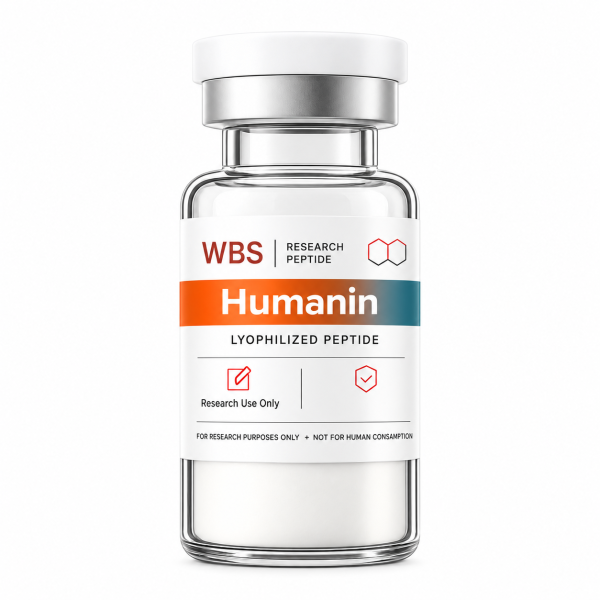
Shipping estimate for one unit of the default specification to the United States: $45.00 USD . Final shipping depends on your cart and destination at checkout.
Humanin (HN) is a 24-amino-acid research peptide associated with mitochondrial-derived peptide biology. It is studied in laboratory models of cell survival, mitochondrial apoptosis and receptor-mediated stress signaling. For laboratory research use only.
Receptor-mediated signaling: cell-based studies have implicated a receptor complex involving CNTFR-alpha, WSX-1 and gp130 in Humanin signaling. In these experimental systems, downstream STAT3 activation was associated with changes in cell-survival responses. Separate studies reported activity at FPRL1, now commonly termed FPR2. Receptor involvement varies with the cell type and experimental model.
Mitochondrial apoptosis research: biochemical and cell studies reported binding between Humanin and the pro-apoptotic protein BAX, reduced BAX movement to mitochondrial membranes and reduced release of cytochrome c in the tested systems. These findings provide research endpoints for studying mitochondrial membrane permeabilization and apoptosis; they do not establish a clinical effect.
Receptor-complex study (2009) · FPRL1 study (2004) · BAX interaction study (2003)
Keep unopened lyophilized vials sealed, dry and protected from light at 2-8°C. Follow the lot-specific expiry date and storage instructions; avoid excessive heat, moisture and repeated temperature changes. Allow a sealed vial to reach room temperature before opening to reduce condensation.
After reconstitution, keep the solution at 2-8°C, protected from light, and label it with the preparation date. Use sterile laboratory handling and a solvent compatible with the lot documentation and assay. Use within 30 days or the shorter period required by your validated stability protocol. Avoid vigorous shaking and repeated freeze-thaw cycles. Do not use material with a damaged seal, persistent particles, unexpected cloudiness or discoloration.
No. HNG contains a serine-to-glycine substitution at position 14. Humanin and HNG are different sequences; a published method using HNG should not be assumed to use the product sold here. Check the sequence in the paper and the lot documentation.
A small mass of lyophilized peptide can appear as a thin film, a small cake or residue on the vial wall. Appearance alone does not establish peptide mass, purity or identity. Review the lot-specific analytical documentation if quantitative confirmation is needed.
Confirm the solvent, pH and target concentration against the lot instructions and your validated assay method. Mix gently rather than shaking vigorously. If particles or cloudiness persist, stop using that preparation and contact support with the lot number, solvent details and photos. Do not assume that every peptide uses the same solvent.
Use the nominal mass per vial, final solution volume and the reference molecular weight, adjusted where appropriate for the documented peptide content, counterion and terminal form. A kit contains 10 separate 10mg vials; 10mg is not the total mass of the kit.
No. Humanin and MOTS-C are different peptides with different sequences and research targets. Match the exact molecule and sequence specified by the experiment.
Check whether the study used Humanin, HNG or another analogue; then match the assay model, material identity and analytical controls. Receptor expression and experimental conditions can change the observed response.
Keep it protected from light at 2-8°C, date the preparation and follow the shorter of 30 days or the stability limit established for your assay. Avoid repeated freeze-thaw cycles and discard preparations if contamination is suspected.
Contact our online support for real-time communication about products, orders, shipping, payment, or bulk supply.